
Table of contents
The question I get asked most is "What exactly is it that you do as Head of Research and Insights at INQOVA?" I sometimes wonder that too. For the past few years I have been deep in research, living under my fashion rock. One week I was analysing trade data and building databases. Next, I was crafting interviews and surveys for brands and suppliers, to understand the relationship between them. From the work I have done in this role, I soon found that the one word I would use to describe the fashion industry is chaos.
Somewhere in the middle of exploring how AI tools could support that work, ChatGPT crowned me the "MECE queen of chaos control," for "turning every tangled web of textile data, diagnostics and supplier drama into perfectly colour-coded revelation, with footnotes, naturally." To my surprise, that summed up the first year of the role better than I could have. This got me thinking. I have spent the last ten years, through my education and my career, looking at how complex and interconnected this industry is, and how ugly but also how beautiful it can be. The harder question is, how do you study chaos? How do you untangle it enough to understand, and use that to solve some of fashion's challenges?
The chaos comes from the complexity of an interdisciplinary industry. We tend to look at fashion through one lens, as an art, a science or a business, when it is all three at once, and it has to be looked at holistically, as a system. You have to hold all three to see the variables in any problem you are trying to solve, and that means taking each part on its own before putting them back together.
It is easy to get so caught up in the challenges that we miss the detail of how the whole system actually works. We then overcomplicate things with jargon and a constant need to reinvent problems and words. Take the supply chain. It became the value chain, then the value network, then the ecosystem. However, the stakeholders and the problems, the fabric mills, the freight and the delays, stayed exactly where they were. Rather than giving the problem a new name, we should break it down, organise it into its simplest form, and taxonomise the language so that we can talk about it before we try to solve it.
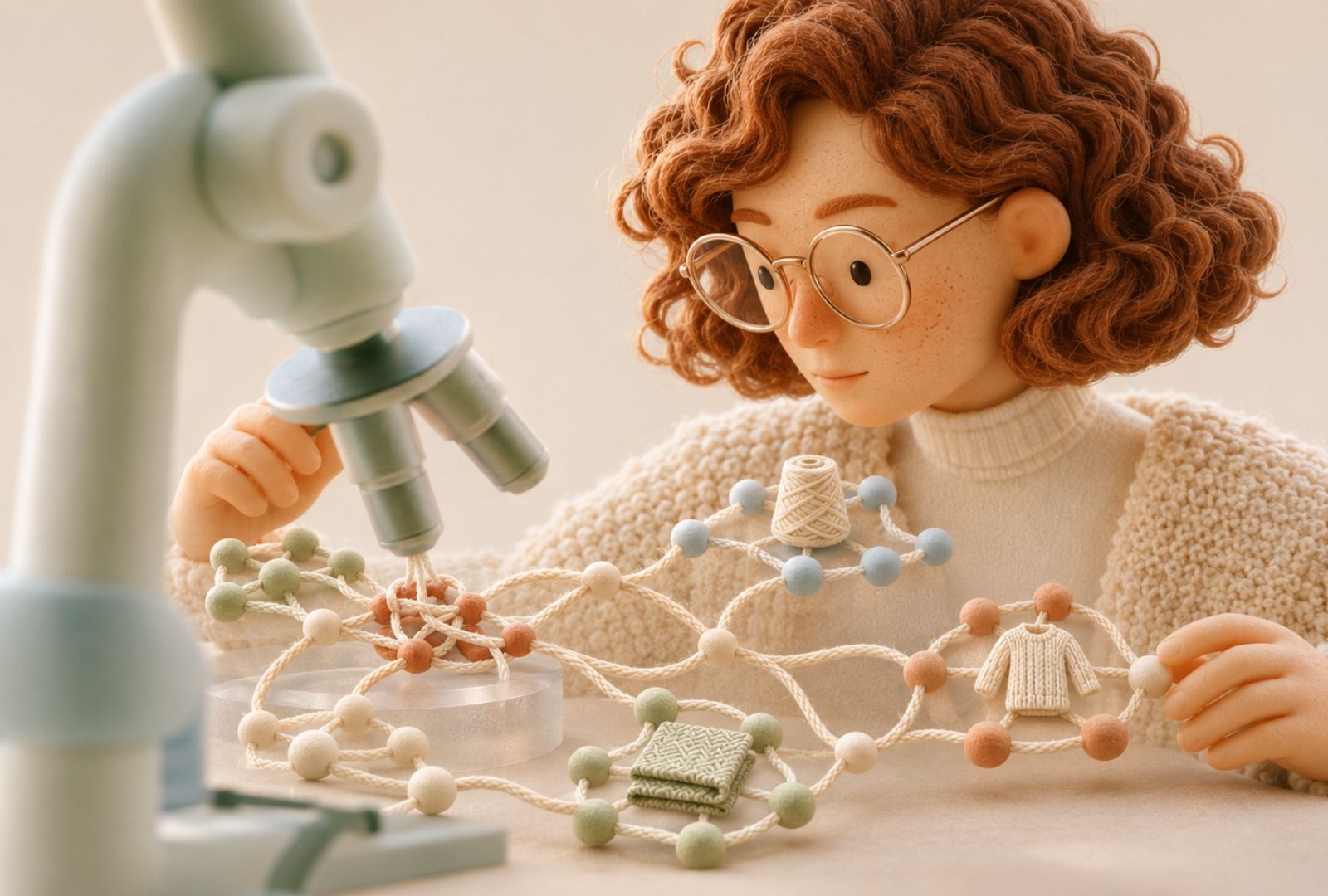
It is like chemistry class. Once something undergoes a chemical reaction, say baking a cake, you cannot undo the cake. You can pull it apart and put it under a microscope and try to work out the ingredients, but why make it harder when you could just start with the person writing the shopping list?
This is what INQOVA has set out to do from the beginning, to focus on yarn, fabric and garments, on how suppliers run their businesses, and on how buyers buy. The cake is the fashion industry, and the shopping list is the yarn, the fabric and the garment. Could we study it from there, and shape strategies from what we find?
What does this mean in practice? It meant first understanding that business. When I joined the team in February 2025, we went back to basics with three questions, one a week, and read everything we could find on each.
Here is what we found on each.
- How do fabric mills sample? Physical samples, such as the swatch book, the shade card and the sample sent in the post, are still essential for evaluating the fabric, and a bulk order is rarely placed before the buyer has touched it. The fabric mill treats the cost of all that sampling as a cost of doing business.
- How does a fabric order actually get placed and confirmed? By email and phone, with the paperwork kept in spreadsheets and on paper and the order waiting for someone's approval at every step.
- What software do fabric mills use? Usually several, and few of them talking to each other. A system for one thing, a spreadsheet for another, a whiteboard for the rest. Larger fabric mills tend to have ERP, the main business software, but in the studies we read, some used it only for financials and inventory.
What we found is that the system works for the people inside it. It is efficient, in its own way. It has been delivering the same goods through the same relationships. Take the sample. It wins the sale, so the samples keep going out, and the fabric mill carries the cost. However, the way samples are handled is not effective. Too many samples go out to leads that were never qualified, and we found that fabric mills tend to undervalue what sampling costs.
The challenges we talk about are almost always consumer-facing, at the end of the supply chain, with retail, sustainability and what consumers want. Could we update these traditional processes and solve some of fashion's challenges? That means putting our resources and our research further up the supply chain, so that everything downstream works better because of it.
This series is an inside look from underneath my fashion rock. It is the journey of what I have been doing for the past two years, with the evidence. Along the way you will see the questions we asked, and the subjects we had to look at to answer them, from trade flows in the CAFTA-DR region to how a firm behaves under pressure. You will see the tools that came out of it, like a profiling tool for studying that behaviour. All of it serves one question and one purpose. The question is how buyers buy. The purpose is supporting suppliers in their business. By the twelfth piece I will have answered the question I started with. What exactly is it that I do? What I have found is that it is not one thing. It is a blend, and it is an exploration.
If you read this series and think I have got something wrong, tell me. I would rather get to the bottom of it together than be right on my own.
Sources and references
INQOVA research reports 01, "Diagnosing Sampling Problems in Fabric Mill Sales" (7 February 2025); 02, "Diagnosing Inefficiencies in Textile Fabric Trade" (13 February 2025); and 03, "Mapping Digital Management Systems Used in Textile Fabric Mills" (20 February 2025). Desk studies of trade and industry sources.